How does it eel?... smoker at work
totalcontent is just back from its annual away-weekend in Holland. This time we took in the Stanley Kubrick show at Eye, the impressive new film museum on the north bank of the Ij, as well as a noteworthy North Sea Jazz Festival in Rotterdam.

But it was one of those chance, totally bizarre encounters that lingers in the memory. Or should that be nostrils? On the Sunday between showers, we decided to take a stroll through Monnickendam, one of a series of picturesque medieval villages perched on the banks of the Ijsselmeer.

Apart from its less-than-charitable attitude towards witches in the olden days, Monnickendam is best known for its ancient tradition of fish smoking. And this happened to be the day of the annual smoke off, when over 100 competitors from the Amsterdam area converged to see who could smoke the tastiest eel (paling) or mackerel.

stamp of approval.

I’ve written plenty of words about stamps for Royal Mail, and I’ve contributed to Design Week’s Vox Pop several times. But you could have knocked me down with a feather when my name appeared in an answer to the question...

‘Who in the design industry would you like to see celebrated in stamp form?

Here’s what Phil Jones, founder of Real Time Consultancy and old friend had to say:

I live in Bloomsbury and my house has a blue plaque on it for the writer Dorothy Sayers who lived here in the 1930s. Other houses around my area have the same blue plaques recognising great writers, Charles Dickens in the next road to me for instance. Wouldn’t it be nice if we recognised the writers who make the design industry tick? Every annual report, brochure, ad campaign is written by great wordsmiths and many of them are unsung heroes. People like Patrick Baglee, Jim Davies, Tim Rich etc., are worth their weight in gold and how nice if we saw them smiling back at us from a stamp?


Thanks Phil, always good to feel appreciated.

Bleedin’ ’eck... the ink went straight through 
The writer’s trustiest companion is his notebook. Over the years I’ve become something of an aficionado, and when I occasionally stray from the tried-and-trusted path, I usually regret it. Like this seemingly attractive £2 sale bargain from Sainsbury’s (top), which turned out to have a really bad case of bleed through and was abandoned after just six pages.

My preference is for an A5 hardcover (orange if possible) with 90gsm gridded paper. Quo Vadis Havanas are particularly durable and satisfying to write on, and I’m also partial to Rhodia Webnotebooks, which come in a really great dot gridded option. As a work essential that you’re going to live with for six or so months, it’s worth plumping for something with decent quality paper that can take all kinds of inks and abuse.
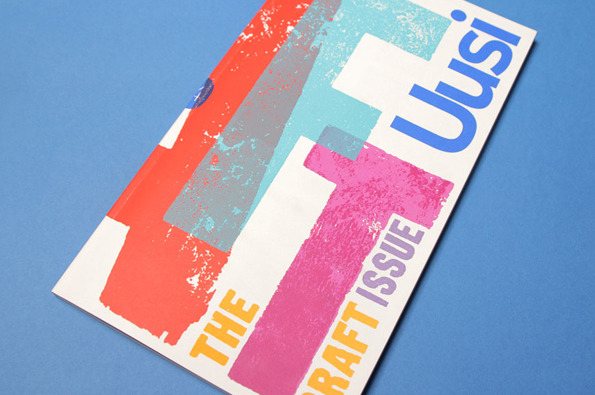
For a large proportion of 2011 and the beginning of this year, we were working with Nokia’s Head of Art Direction Richard Crabb and DesignStudio on Uusi magazine. It’s a quarterly brand publication that goes to Nokia internal marketing types and external agencies to keep them up to speed with all the creative work that’s going on in different parts of the world… and to get them fired up.

Kitching cabinet... cover art by the master of letterpress
In an odd way, it’s been like going back to our roots working on design publications — only Uusi is more creatively ‘out there’ than most regular industry mags. DesignStudio’s background is more branding than editorial, so their take on magazine design is pretty expressive and experimental, all held together by a modernist, grid-based aesthetic.
Stefan Sagmeister and Jessica Walsh... as nature intended
Stefan Sagmeister has his kit off again. This time to announce that his New York design practice is becoming Sagmeister & Walsh, with 24-year-old designer Jessica Walsh getting her name on the door and her very own naked photo alongside the great man.

Of course this bare-faced stunt prompted all kinds of barbs from the design industry… Alan Aboud tweeted “designers reaching new extreme depths in self promotion. Awful.”, Rob Ball of The Partners weighed in with “you know what would be eye-catching? Something involving Sagmeister without his cock in it #tiresome”.

What most struck me though was how grumpy Sagmeister and Walsh looked. There seemed to be no joy in the occasion, just a sense of morose resignation and even boredom. Sagmeister had left his socks on, Walsh perched on a stack of magazines, they stare straight at camera, stark miserably naked. You’re just left wondering what’s the point and what’s the fuss?

Newcastle studio onebestway on dress-down Friday 
A couple of years ago I wrote a Design Week column (no innuendo intended) centred around onebestway, an eight-strong Newcastle design agency who went naked for a day on the advice of a business psychologist. Their publicity photo was more ‘Carry On Designing’ than a po-faced art piece, with strategically placed laptops, chairs and fruit bowls hiding their modesty. Mind that stapler. At least they seemed to be enjoying themselves.

There’s certainly nothing clever about taking your clothes off... I strip every day and barely give it a second thought. And it’s been done so many times and in so many contexts, that as a gesture it’s barely provocative any more. But I think the reason that Sagmeister has ruffled so many feathers this time is that designers feel they should be judged by their work rather than talent for exposure. After all, they’re supposed to drive the car, rather than pose naked on the bonnet.

As Englebert Humperdink gets cosy with the throat gargle on the eve of tomorrow’s Eurovision Song Contest, I thought I’d take a quick delve into the Netherlands’ fortunes over the years.

Like the UK, the Dutch glory days were the 1970s, notably when Teach-In scooped the top prize in 1975 with the quintessential Eurovision ditty ‘Ding-A-Dong’, and various other patriotic crooners snaffled second and third places. There have been another three Dutch winners all told, but you have to go right back to the 1950s and 1960s to sniff those out.

Some of the more curious names to represent the Netherlands include Frizzle Sizzle (1986), Mrs Einstein (1997), Mouth & MacNeal (1974), Hind (2008) and the curiously British-sounding Humphrey Campbell (1992). In latter years entries have tended to be sung in English, though personally I feel ‘Een speeldoos’ (‘A Musical’), ‘De mallemolen’ (‘The Whirligig’) and ‘Blijf zoals je bent’ (‘Stay As You Are’) have a certain authentic ring to them.

However, Teach-In’s strategy of using catchy but meaningless words clearly doesn’t always pay off… in 1967, Thérèse Steinmetz came last and managed only two points with ‘Ring-dinge-ding’.

The 2012 entry ‘You and Me’ by Joan Franka didn’t make the cut, which means the Netherlands have failed to make the Saturday night final for eight years on the trot. Still, so long as the boys in orange make it to the other Euro final, who cares?


Size matters... The Sweet touted the more obvious side of Glam
Last year ‘Electric Warrior’, T-Rex’s seminal sixth album turned 40. This year ‘Ziggy Stardust and the Spiders from Mars’, Bowie’s breakthrough record hit the same milestone. So I thought I’d quickly doff my spandex cap to Glam Rock, the genre that made it OK for boys to deviate musically and sartorially… and make the odd foray into their girlfriends’ make-up bags.

Of course, not all the lads were comfortable with the Glam look. Word magazine ran a picture last month of Trevor Bolder and Woody Woodmansey from Bowie’s original backing band, looking more like Men from C&A than Spiders from Mars. They revealed that Bowie’s sideman Mick Ronson hated the clothes so much, “he packed and left for Beckenham Station”. ‘The Great’ Paul Thompson, drummer with Roxy Music, former apprentice welder at the Palmers shipyard in Jarrow, was another who had something of an allergic reaction to glitter and platforms.

While Bowie, Bolan and Roxy have stood the test of time and remain hugely credible artists, I’d like to put a quiet word in for The Sweet. Unashamedly poppy, with brazenly catchy songs written by the prolific Nicky Chinn and Mike Chapman, they scored an amazing 13 top 20 hits during the 1970s, with ‘Blockbuster’ topping the charts in 1973. Though the title of highly successful 2006 BBC time-warp series ‘Life on Mars’ nods to a Bowie song, its 1970s soundtrack, tellingly enough, was dominated by The Sweet.

With it’s rejection of hippie mores and free licence to experiment, Glam paved the way for its spiky younger sibling Punk… and for that, we a have a lot to be grateful for.

By George... this looks damn familiar
I’ve just been reading a book by the celebrated US art director George Lois. Lois was not only responsible for some of the most seminal ads of the 1960s and 1970s, but his extraordinary covers for Esquire magazine are now on permanent display in New York’s MoMA. The slim volume is called ‘Damn Good Advice (for people with talent!)’, and consists of a series of illustrated lessons culled from his many years in advertising and publishing.

If you’ve read Paul Arden’s ‘Whatever You Think, Think The Opposite’ and ‘It’s Not How Good You Are, It’s How Good You Want To Be’, you’ll get the gist. It’s a collection of snappy, from-the-horse’s-mouth pointers on how to be creative. In fact, the format is remarkably similar — standard paperback size, white cover with bold black type. Inside, brutally straightforward, sometimes irreverent headlines, accompanied by a couple of paragraphs of wisdom or anecdote, and a carefully chosen image that colours or juxtaposes the point being made.

The pace is staccato and relentless. You feel you’re being hit over the head with page after page of ‘damn good advice’ — ‘Make your surroundings a metaphor for who you are’, ‘Never eat shit’, ‘A trend is always a trap’, ‘Tell the Devil’s Advocate in the room to go to hell’, ‘Speak up, goddammit!’. For full effect shout rapidly in a Noo Yoik accent.

The first few pages are fine, inspiring even. You’re thinking, right on, don’t compromise, fight the good fight, believe in yourself, stick it to the man. But as they keep coming (and coming) small seeds of doubt start creeping in. Firstly, it starts to become apparent that a lot of the ‘damn good advice’ is pretty self evident. Like ‘Don’t sleep your life away’, and ‘Don’t expect a creative idea to pop out of your computer’. You can’t argue with either, but most people will have worked this out for themselves. Unless they were sleeping, of course.

Arden fast rules... an adman’s wisdom
Secondly, if I took every leaf out of Lois’s book, I’m pretty sure my clients would run a mile. For example, he recalls a time when he stood on a window ledge and threatened to jump unless his poster idea was accepted. Or dropped the biggest book he could find on the floor when his boss was ignoring him. It’s the kind of ‘maverick’ behaviour that pervaded UK advertising in the 1980s, ‘crazy creative guys’ throwing more and more outrageous stunts to get noticed.

Of course be determined, confident and original. Of course stick up for your ideas and take inspiration from wherever you find it. And I tip my hat to Lois for his single-mindedness, chutzpah and towering achievement. But, I can’t help feeling that if there were 100s of creative people out there following this credo, we’d have mayhem on our hands. The point is, we’re all creative in different ways, and realising this is the first step on the path to originality.

‘Damn Good Advice’ is a damn good ad for George Lois, but you need to take it with a pinch of salt. Or as he might put it ‘You can't be creative if someone has to tell you how’.

It almost goes without saying that being foreman of this year’s D&AD Writing for Design jury was the next best thing to shaking Johan Cruyff’s hand. As you walked into the vaulted expanse of Olympia, with the sun shining through the latticed ceiling, it felt like you were in some kind of creative heaven — only without the blessed harps and angels. There was table after groaning table of the best work in the world, stretching off into the horizon, a seemingly endless feast of ideas and perspiration.

On our six tables, there were 70-odd entries including books, bottles, posters, mailers, annual reports, leaflets, cards, websites, three bikinis and a pair of vibrators. My fellow jurors (Nick Asbury, Fiona Thompson, Chris Doyle, Lisa Desforges, John Weich and Anelia Varela) were as keen as I was to get stuck in, to be inspired and informed, amused and amazed. But it soon became apparent that, although the overall standard was well above middling, there was very little to make the soul rejoice and the heart sing. Yes, there was plenty of perfectly accomplished, lively, well-crafted writing, but very little with the glimmer of greatness required for the pages of the hallowed D&AD Annual.